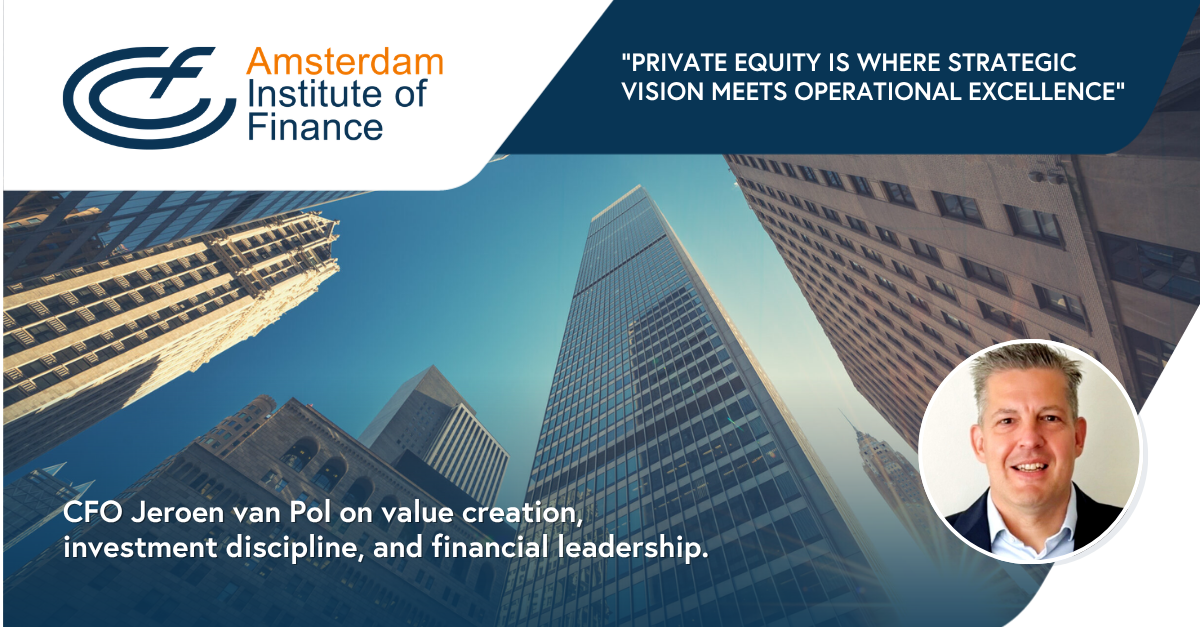
Part 4 of our ‘Participant’s Perspective’ series: Lessons in value creation, investment discipline, and financial leadership
Private equity is often discussed in terms of capital, transactions and returns. Yet behind successful investments lies a broader and highly structured process: from raising capital and evaluating acquisitions to identifying value drivers, improving operations and preparing for long-term growth.
For Jeroen van Pol, the Private Equity program at the Amsterdam Institute of Finance offered a valuable opportunity to better understand that process from the inside. Having worked for many years in various finance roles, he wanted to deepen his understanding of the philosophy, methodology, and financial dynamics behind the private equity sector.
The program changed his view of private equity. Van Pol came to see it not simply as a vehicle for generating returns, but as a structured approach to strengthening companies strategically, operationally, and financially. We spoke with him about value creation, investment discipline, and why private equity offers relevant lessons for finance leaders far beyond the sector itself.

Jeroen van Pol, Strategic CFO and Chartered Controller
“The objective is not simply to improve financial performance, but above all to make the company stronger, more sustainable, and better prepared for the future.”
Beyond returns: a structured approach to value creation
Jeroen van Pol entered the program with a clear learning objective. He wanted to better understand the philosophy behind private equity, how its approach is structured, and how the sector has evolved.
“During the program, my perception changed significantly. I learned that private equity is built around a structured framework in which value creation is central. A company’s strategic, operational and financial development is assessed from multiple perspectives. The objective is not simply to improve financial performance, but above all to make the company stronger, more sustainable and better prepared for the future.”
He describes this approach as a form of financial innovation because it integrates financial, strategic, and operational decision-making within a single methodology. “Although the approach differs from one company to another, the framework provides a clear methodology for helping businesses remain successful over the long term.”
Van Pol believes that some companies have been able to survive and develop successfully precisely because of the private equity approach. “Without this structured approach, some companies might no longer have been viable if they had continued to operate solely according to a traditional business model. I believe the knowledge and methodologies used in private equity are relevant not only to PE-backed companies, but to any finance professional working in strategy, financing, and sustainable value creation.”
“Decisions are not based on intuition alone, but supported by fundamental, strategic, and quantitative analysis.”
A structured framework for better decision-making
The philosophy and investment framework of private equity were the biggest eye-opener for Van Pol. “I was impressed by the structured way in which the entire process is organized, from raising capital and completing acquisitions to identifying and analyzing a company’s most important value drivers.”
That analysis then provides the foundation for targeted value creation and the effective allocation of capital. “What appealed to me most was that every decision is supported by fundamental, strategic, and quantitative analysis. As a result, choices are not based solely on intuition, but on facts and a clear methodology.”
The financing mechanics of private equity and the broader investment process were relatively new to him. During the program, he also gained a clearer understanding of the attention private equity firms devote to business transformation, operational improvement, and strategic value creation.
“In my view, these principles are not only relevant to private equity, but also to companies more broadly. I believe many businesses would benefit from applying this approach in a more structured way to achieve sustainable growth and value creation.”
Private Equity: discover how value is created in deals
How do private equity funds operate, what drives returns, and how is value created after an investment is made? In the three-day Private Equity program at the Amsterdam Institute of Finance, participants explore fund structures, deal analysis, buyouts, governance, performance measurement, fundraising, and value creation.
Professor Cyril Demaria brings together theory, current market developments, and real-world cases in an intensive program for finance professionals, investors, and executives.
View the program for more information.
Connecting finance, operations and stakeholders
The program not only provided valuable insight into the private equity investment framework and its structured process, but also served as a valuable refresher on financial disciplines he had encountered earlier in his education. Topics such as corporate finance, investment and return analysis, management accounting, financial accounting, and strategic value creation were brought together within a coherent framework.
“What I also found particularly valuable was the emphasis on the broader value creation process. The focus is not only on financial analysis, but also on how that value is communicated to different stakeholders.”
The program gave Van Pol a comprehensive view of how financial strategy, operational improvement, and stakeholder management can reinforce one another. The five stages of the investment process provided a clear structure. According to Van Pol, they were presented in an accessible, practical, and informative way, allowing theory to be connected directly to day-to-day practice.
“It is precisely this combination of strategic insight, financial depth, and concrete real-world examples that makes the program highly valuable for professionals who want to develop further in a financial or executive role.”
“Private equity methodologies are relevant not only to PE-backed companies, but to any finance professional working in strategy, financing, and sustainable value creation.”
The value of theory and practice
The program is taught by Professor Cyril Demaria, a private markets specialist and the author of several books on private equity and asset allocation. Van Pol was particularly impressed by the combination of academic theory and Demaria’s extensive practical experience. “His in-depth knowledge of private equity, developed through many years of experience as both an investor and a professor, gave the program significant depth and credibility.”
Throughout the three-day program, theoretical concepts were continually illustrated with practical examples and real-world cases. “This not only brought the methodologies and models to life, but also made clear how they are applied in practice. That combination of theory and real-world application added an important dimension to the program for me.”
Cyril Demaria also discussed the historical development of the sector and the changes the market has undergone in recent years. “That historical context, combined with his personal experience, provided valuable insight and made the program highly current and relevant.”
What stayed with Van Pol most were the many practical examples and cases discussed during the program. “They made the theory tangible and gave me a better understanding of the philosophy behind private equity and how sustainable value creation is achieved in practice. Thanks in part to the interactive format and Demaria’s expertise, I found the program both highly valuable and inspiring.”
Relevant far beyond private equity
Van Pol recommends the program not only to professionals working directly in private equity, but also to finance professionals who want to better understand value creation, investment discipline, and financial leadership. “It provides an excellent introduction to the world of private equity and the financial principles and developments that shape the sector. The topics covered are not only relevant to private equity, but are also directly applicable to the day-to-day work of any finance professional.”
The interactive format also made an important contribution to his learning experience. “The international mix of participants led to interesting discussions, the exchange of practical experience, and valuable new connections. Overall, it was an insightful and inspiring program that I would wholeheartedly recommend to any senior finance professional.”
Read more: Strategic Silence: How Turkmen Demirci (Rabobank) learned to see leadership differently
Meet Jeroen van Pol
Jeroen van Pol is a CFO and senior finance leader with more than 20 years of experience in driving EBITDA growth, cash discipline, and performance transparency in complex, international businesses. He has held senior finance positions at Philips. Connect with him on LinkedIn to share insights and ideas.
Private Equity: discover how value is created in deals
How do private equity funds operate, what drives returns, and how is value created after an investment is made? In the three-day Private Equity program at the Amsterdam Institute of Finance, participants explore fund structures, deal analysis, buyouts, governance, performance measurement, fundraising, and value creation.
Professor Cyril Demaria brings together theory, current market developments, and real-world cases in an intensive program for finance professionals, investors, and executives.
View the program for more information.
Looking for personal advice? Contact AIF: +31 20 246 7140 | info@aif.nl