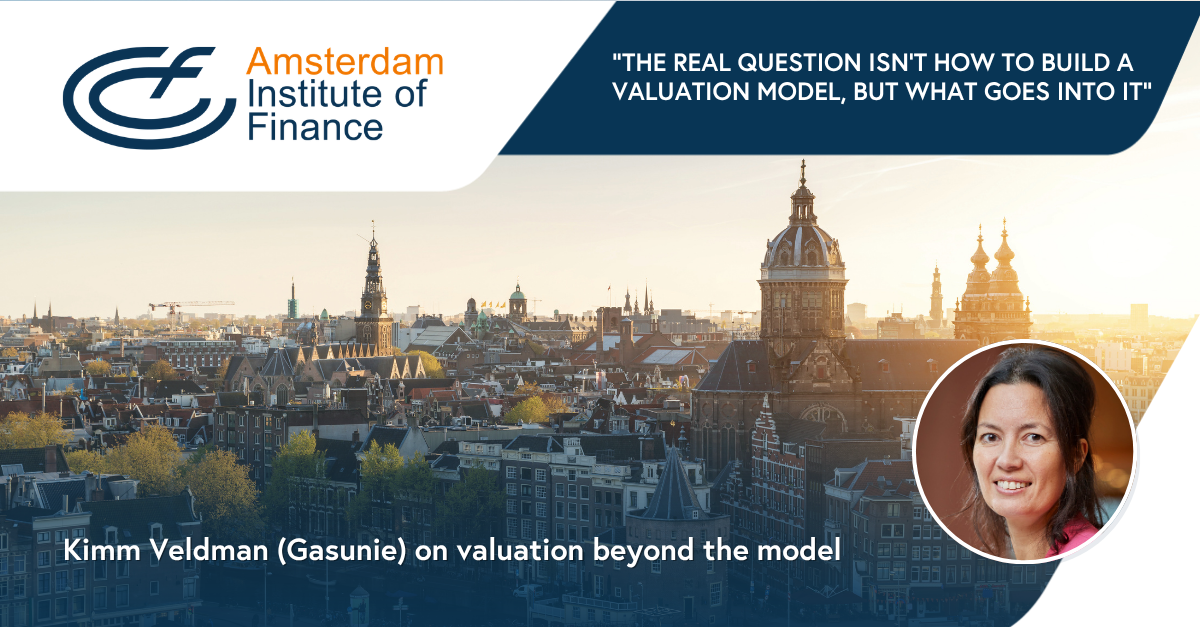
Part 5 of our ‘Participant’s Perspective’ series: Lessons in valuing emerging markets, challenging assumptions, and making better decisions.
A valuation model can be technically flawless and still say very little about the true economic value of an investment. Especially in markets that are still emerging, where regulation plays a defining role and historical benchmarks barely exist, the questions behind the model become just as important as the calculations themselves.
For Kimm Veldman, Coordinator unit Treasury and Senior Economic Advisor at Gasunie, this became one of the most valuable lessons from the Advanced Valuation program at the Amsterdam Institute of Finance. The biggest insight was not how to build better models, but how to think more critically about the economic logic behind every business case.
Veldman reflects on valuing investments without historical reference points, the limits of financial models, and why better decision-making starts with asking better questions.

Kimm Veldman, Coordinator Treasury and Senior Economic Advisor, Gasunie
“You don’t necessarily learn how to build better models, you learn how to ask better questions. And ultimately, those questions lead to better decisions.”
Value starts before the model
The fundamentals of discounted cash flow (DCF) valuation were already familiar to Veldman before attending the program. Yet Advanced Valuation brought her back to the question that precedes every financial model. “What stayed with me most was the fundamental question: Why would customers actually want this product or service? What problem does it solve? What advantage does it offer over the alternatives? And is that advantage strong enough for customers to keep choosing it over the long term?”
Those questions, she argues, come before any credible valuation. “If you can’t identify a convincing competitive advantage, it’s difficult to believe a product or service will succeed in a competitive market. When customer demand depends primarily on subsidies, regulation or pricing mechanisms, such as measures within the European Emissions Trading System (ETS), the business case becomes dependent on forces outside the market itself.”
That does not mean such investments lack economic or societal value. It does mean different questions deserve greater attention. “How resilient is the business case if supporting policies change or disappear? Which regulations underpin the investment? And how much economic value remains if policy shifts?”
Since completing the program, these questions have become increasingly central to the projects she works on at Gasunie. “I spend less time looking at the output of a model and more time examining the underlying economic logic. Why would customers choose this? Which financial drivers are within our control? Which are not? And how does the political landscape influence the assumptions supporting the business case?”
“How do you value something when the market barely exists?”
Valuing the unknown
Those questions have become increasingly relevant. At Gasunie, valuation is no longer limited to investments in established markets with well-understood pricing mechanisms, historical data and mature customer relationships. “Perhaps the work carried out by Gasunie’s valuation team is considerably more challenging today than it was in the past,” Veldman says. “Not because the models have become more complicated, but because the questions have become far more fundamental.”
The company has long embraced principles that are also central to the approach of Professor Kevin Kaiser, Adjunct Professor of Finance at the Wharton School and former Professor at INSEAD: challenging assumptions, questioning the data you’re given, and continually searching for the underlying sources of value. What has changed, however, is the context.
“Where we once evaluated projects in existing markets, we are now working on projects that are creating entirely new markets.”
That fundamentally changes the valuation challenge. “The value of these projects is not determined solely by future cash flows. They are also expected to deliver societal benefits such as sustainability, security of supply and climate objectives. That raises questions for which no handbook exists. How do you value something when the market barely exists? And how do you discuss risk with the Board when there are no historical benchmarks and the future is inherently uncertain?”
While Advanced Valuation does not provide definitive answers to those questions, Veldman says the program offered four invaluable days to challenge business cases, debate uncertainty and critically examine risk alongside Professor Kevin Kaiser.
Advanced Valuation: Look beyond the model
Valuation is about far more than a DCF model, a WACC calculation or a spreadsheet. In the four-day Advanced Valuation program at the Amsterdam Institute of Finance, senior finance professionals, investors and strategic decision-makers explore the economic logic that underpins valuation and long-term value creation.
Professor Kevin Kaiser challenges participants to think critically about assumptions, future cash flows, risk, the cost of capital and the true drivers of economic value. Develop deeper insights into how value is created, challenged and assessed.
View the program for more information.
The assumptions behind the model
According to Veldman, Kevin Kaiser’s teaching style differs markedly from that of many traditional finance programs. Participants expecting a new valuation framework or a collection of formulas to take home are likely to be surprised. “Apart from a useful refresher on a handful of formulas, you actually learn remarkably little that you can simply write down and look up later.”
That, she explains, is entirely intentional. “The program assumes you already understand the mechanics of a DCF model. The real question isn’t how to build a model, but what goes into it. And that is where Kevin Kaiser is exceptional. He doesn’t teach a formula or a checklist. He teaches a way of thinking, using highly recognizable and engaging real-world examples.”
As a result, the focus shifts away from the model itself and toward the quality of the assumptions that underpin it. “It changes the way you think for the rest of your career. You become much more critical of the assumptions behind every valuation and business case. Are these inputs actually valid? Which assumptions am I accepting without questioning them? And why do I believe this value will actually materialize?”
The emphasis moves from financial mechanics to economic logic. To get the most from the program, however, participants need to embrace Kevin Kaiser’s teaching philosophy. “Be willing to ask questions. Be willing to challenge your own conclusions. And don’t be afraid to change your mind when new insights emerge. Most importantly, start from the assumption that you don’t already know the answer.”
Learning to doubt at the right moment
For Veldman, one of the program’s greatest lessons lies in recognizing the value of doubt. “You learn to doubt at exactly the right moments. Not because you become less confident, but because you become much better at recognizing where the real risks and uncertainties lie.”
That mindset also changes what good financial decision-making looks like. Rather than presenting a single, seemingly precise valuation, the emphasis shifts toward making the underlying assumptions, dependencies and uncertainties visible.
According to Veldman, those lessons extend far beyond valuation itself. “You learn to think more critically, understand more deeply where value actually comes from, and challenge the assumptions underlying investment proposals. Those are insights I apply every day in my work at Gasunie.”
Beyond the spreadsheet
That, Veldman believes, is ultimately the strongest reason to recommend Advanced Valuation to fellow finance professionals.
“I would recommend the program to anyone who wants to look beyond the spreadsheet. It doesn’t simply teach you how to calculate value, it teaches you how to think critically about where value actually comes from. Kevin Kaiser constantly challenges you to question your assumptions and to keep asking one fundamental question: why would a customer choose this?”
For professionals involved in investment proposals, business cases and strategic decision-making, she believes that perspective is invaluable. “You don’t necessarily learn how to build better models, you learn how to ask better questions. And ultimately, those questions lead to better decisions.”
Read more: Jeroen van Pol on private equity: ‘Where strategic vision meets operational excellence’
Meet Kimm Veldman
Kimm Veldman is Coordinator Treasury and Senior Economic Advisor at Gasunie. As Coordinator of the Treasury unit within Corporate Finance, she is responsible for cross-departmental initiatives, including strategic positioning, objective setting, internal and external collaboration, training, and team development.
In addition, she serves as Senior Economic Advisor for the Dutch national onshore hydrogen network (Waterstofnetwerk Nederland). Connect with her on LinkedIn to share insights and ideas.
Advanced Valuation: Gain new insights into company valuation
Valuation is about far more than a DCF model, a WACC calculation or a spreadsheet. In the four-day Advanced Valuation program at the Amsterdam Institute of Finance, senior finance professionals, investors and strategic decision-makers explore the economic logic that underpins valuation and long-term value creation.
Professor Kevin Kaiser challenges participants to think critically about assumptions, future cash flows, risk, the cost of capital and the true drivers of economic value. Develop deeper insights into how value is created, challenged and assessed.
View the program for more information.
Looking for personal advice? Contact AIF: +31 20 246 7140 | info@aif.nl