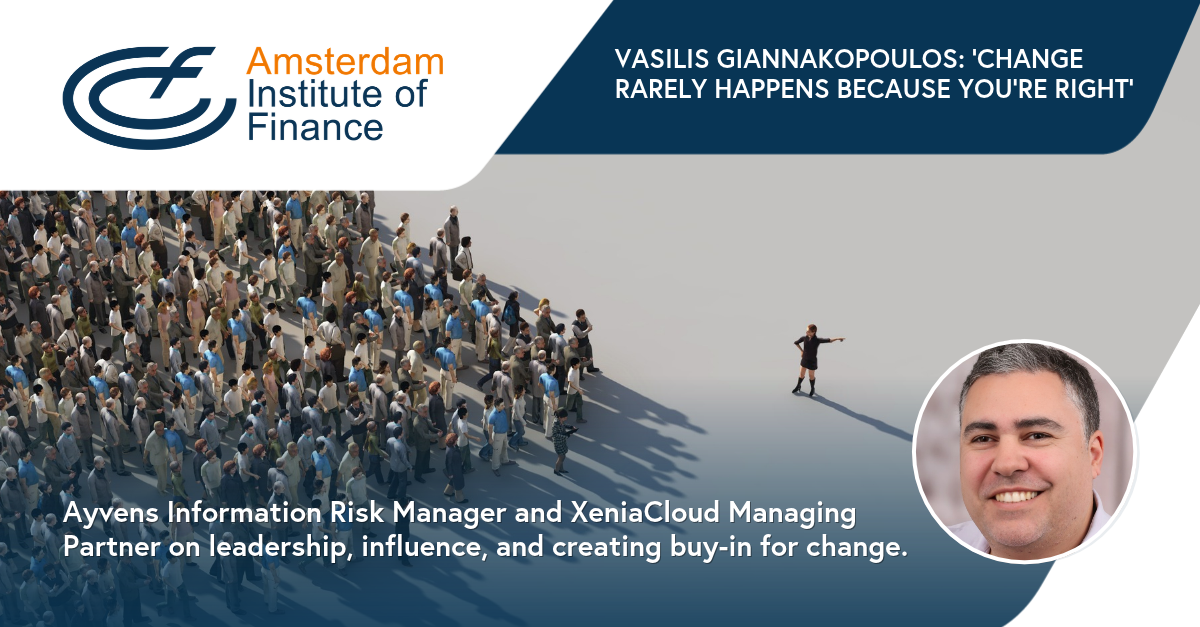
Part 6 of our ‘Participant’s Perspective’ series: Lessons on empathy, influence and why creating change requires more than having the right answer.
Being right is rarely enough to make change happen. In complex organizations, professionals may have the facts, expertise and arguments on their side, yet still struggle to bring colleagues and stakeholders with them. Leadership therefore requires more than knowing what needs to change: it requires understanding how people receive a message and what creates genuine buy-in.
That is a lesson Vasilis Giannakopoulos knows well from his work as Information Risk Manager at Ayvens. Working across teams and stakeholders, he operates in an environment where technical expertise and risk awareness have to translate into action.
During AIF’s Leadership: Influencing People & Managing Change program with Professor Marwan Sinaceur, he discovered that influencing, communicating and creating buy-in are not different names for the same thing. They are distinct leadership skills, and developing all three starts with understanding people.
“In large organizations, change rarely happens because you’re right. It happens because you’re able to influence, communicate and create buy-in.”

Vasilis Giannakopoulos, Information Risk Manager at Ayvens
Empathy is not enough
One of Giannakopoulos’ most valuable insights initially sounds deceptively simple. The problem in professional interactions, he realized, is often not that people are unable or unwilling to empathize with others.
“The biggest lesson for me was that people generally don’t lack empathy, they lack the ability to express it effectively.”
That distinction matters. Understanding someone else’s position internally does not automatically mean that understanding is visible to the other person. For leaders trying to influence colleagues, overcome resistance or guide change, how empathy is expressed can therefore be just as important as the empathy itself.
Being right does not create change
The lesson also made Giannakopoulos look differently at challenges he encounters in his own work. As Information Risk Manager at Ayvens, he works in a large organization where changes around risk and security can involve multiple teams, interests and stakeholders.
“I realized I face the same challenge myself. In large organizations, change rarely happens because you’re right. It happens because you’re able to influence, communicate and create buy-in.”
The program helped him make a further distinction. Influence, communication and buy-in may be closely related, but they are not interchangeable. “This program helped me understand that these are three distinct skills and that all three are essential.”
For professionals whose expertise requires other people to act, that changes the leadership challenge. Having a strong argument is only one part of the equation. The question becomes how to communicate it, how to influence the people involved and ultimately how to create enough support for action.
Want to lead change more effectively?
Join one of Professor Marwan Sinaceur’s highly rated executive programs at the Amsterdam Institute of Finance to turn these insights into action: Leadership: Influencing People & Managing Change and Decision-making in high-stakes situations. Learn more about Professor Sinaceur, explore the programs and enroll here.
Soft on people, tough on issues
A principle from Professor Marwan Sinaceur captured that balance particularly well for Giannakopoulos. “Professor Sinaceur’s message was powerful because it was practical: be soft on people, tough on issues.”
The principle separates the person from the problem. Leaders can remain demanding about an issue, decision or desired outcome without allowing that firmness to become unnecessarily confrontational with the people involved.
For Giannakopoulos, its relevance extends beyond a specific management situation. “That principle applies just as much to leadership as it does to life.”
“Be soft on people, tough on issues. That principle applies just as much to leadership as it does to life.”
Closing the gap between intention and impact
Ultimately, Giannakopoulos’ experience with the program comes back to a fundamental leadership challenge: the gap between what someone intends to communicate and what another person actually hears.
Asked how he would describe the value of the program to a peer, he summarizes it in three steps: “This program helps you understand yourself, understand others, and reduce the resistance that often exists between what you mean and what others hear.”
Being right, then, is only the starting point. Whether the challenge involves risk, finance, technology or organizational change, expertise creates impact only when you can communicate it, influence others and turn understanding into genuine buy-in.
Read more: Strategic Silence: How Turkmen Demirci (Rabobank) learned to see leadership differently
Meet Vasilis Giannakopoulos
Vasilis Giannakopoulos is Information Risk Manager at Ayvens and Managing Partner at XeniaCloud. He has more than 15 years of experience in IT and works across information security, privacy, IT risk management and cyber resilience. In his role at Ayvens, he leads and collaborates across functions, engaging stakeholders and bringing teams together around shared objectives.
He also runs SaVaGi, through which he supports SMEs with IT infrastructure, security and data protection, and holds an MSc in Computer Network Security.
Connect with him on LinkedIn to share insights and ideas.
Want to lead change more effectively?
Join one of Professor Marwan Sinaceur’s highly rated executive programs at the Amsterdam Institute of Finance to turn these insights into action: Leadership: Influencing People & Managing Change and Decision-making in high-stakes situations. Learn more about Professor Sinaceur, explore the programs and enroll here.